Full Spectrum vs Isolate CBD: Understanding the Differences
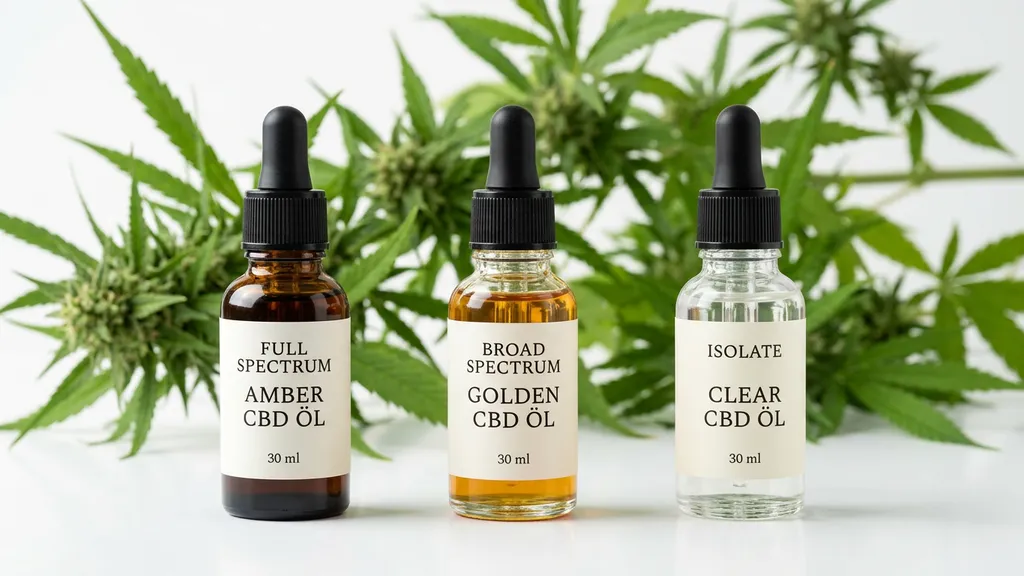
If you've spent any time shopping for CBD, you've probably seen the terms full spectrum, broad spectrum, and isolate thrown around a lot. Understanding the difference between full spectrum vs isolate CBD is the single most useful thing you can learn before making a purchase.
This guide digs into what each type actually is (from CBD oil to CBD extracts), how they work in your body, and which situations call for one over another. Also check out our entourage effect article and the CBD lab certificate guide. By the end, you'll know exactly which option makes sense for you.
What is full spectrum CBD?
Full spectrum CBD is a hemp extract that keeps all the naturally occurring compounds of the plant intact. It's not just CBD: it's the whole package.
Here's what you'll find inside:
- Other cannabinoids: CBG, CBN, CBC, and trace amounts of THC (always below 0.2% to 0.3% depending on local regulations)
- Terpenes: aromatic molecules that give hemp its distinctive smell (myrcene, limonene, linalool, beta-caryophyllene)
- Flavonoids: natural antioxidants from the plant
- Fatty acids and vitamins: omega-3, omega-6, vitamin E, and B vitamins
The entourage effect: why full spectrum stands out
The big deal with full spectrum is something called the entourage effect. The idea (backed by a growing body of research) is that all these hemp compounds work better together than any of them does alone. Each molecule amplifies or fine-tunes the action of the others, creating a combined effect that's greater than the sum of its parts.
In practical terms, terpenes and minor cannabinoids team up with CBD to boost its effectiveness. Myrcene promotes relaxation, for instance, while CBG interacts with different receptors than CBD does, broadening the overall scope of what the product can do.
A landmark study from the Lautenberg Center at the Hebrew University of Jerusalem in 2015 provided some of the strongest evidence for the entourage effect. The researchers compared the effects of pure CBD isolate against a full-plant extract and found that the whole-plant preparation was more effective at higher amounts, while the isolate followed a bell-shaped response curve, meaning its effectiveness peaked and then declined as the amount increased. The full spectrum extract showed no such ceiling. This study, conducted by a team with deep expertise in cannabinoid research, became one of the most cited papers in the CBD industry and is frequently referenced by brands explaining why full spectrum products exist.
The THC question
Full spectrum CBD contains trace amounts of THC, but always below the legal threshold of 0.2% to 0.3%. At that concentration, THC doesn't produce any psychoactive effects: you won't feel high or euphoric. Those traces do, however, play a role in the entourage effect.
The presence of THC, even at such tiny levels, can be a concern for people who face regular drug testing. While the risk of a positive test with a compliant full spectrum product is very low, it can't be entirely ruled out with heavy, prolonged use.

What is broad spectrum CBD?
Broad spectrum CBD sits right between full spectrum and isolate. It keeps most of the cannabinoids, terpenes, and flavonoids from the hemp plant, but the THC has been specifically removed during extraction.
What's in broad spectrum
Broad spectrum includes:
- CBD as the primary cannabinoid
- Minor cannabinoids: CBG, CBN, CBC (same as full spectrum)
- Terpenes: terpene profile preserved (same as full spectrum)
- Flavonoids: present (same as full spectrum)
- THC: removed, 0% or undetectable
Who should consider broad spectrum?
Broad spectrum is built for people who want the entourage effect without any THC exposure whatsoever. It's the natural pick for athletes subject to anti-doping tests, professionals whose jobs involve drug screening, or anyone who simply wants zero THC on principle.
The entourage effect is still there, but it may be slightly reduced compared to full spectrum since one piece of the puzzle (THC) has been taken out.
What is CBD isolate?
CBD isolate is cannabidiol in its purest form. It's CBD that has been completely separated from every other plant compound. The result is a crystal or white powder that's 99% or more pure CBD.
Key characteristics of isolate
CBD isolate stands apart because of:
- Maximum purity: 99%+ CBD
- Zero THC: no traces whatsoever, guaranteed
- No taste or smell: completely neutral, unlike the earthy flavour of full spectrum
- No entourage effect: CBD works on its own, without synergy from other compounds
Advantages of isolate
Isolate brings some specific benefits to the table:
- Precise quantity control: every milligram is pure CBD, making calculations dead simple
- Zero THC risk: perfect for anyone under strict testing protocols
- Versatility: the powder or crystals can be added to food, drinks, or homemade skincare products
- Tolerability: recommended for people who are sensitive to certain cannabinoids or terpenes
Here is an industry anecdote that tells you a lot about how the market has matured: in the early days of the CBD industry around 2016-2017, isolate was actually considered the premium product. Companies marketed 99% pure CBD as the gold standard, and full spectrum products were sometimes seen as less refined. That perception flipped almost entirely once research on the entourage effect gained traction. Today, most reputable brands position full spectrum as their flagship offering, and the industry consensus has shifted to view the "impurities" in full spectrum (those minor cannabinoids and terpenes) as the features, not the bugs.
Where isolate falls short
The lack of an entourage effect is the main downside. Preclinical work from the Lautenberg Center has indicated that CBD on its own can follow an inverted U-shaped dose-response curve: its effectiveness increases up to a certain dose, then starts to drop off. With full spectrum extracts, this limitation does not appear to apply in the same way, which supports the value of the entourage effect.
Comparison table: full spectrum, broad spectrum, and isolate
| Feature | Full Spectrum | Broad Spectrum | Isolate |
|---|---|---|---|
| CBD | Yes | Yes | Yes (99%+) |
| Other cannabinoids | Yes (CBG, CBN, CBC) | Yes | No |
| Terpenes | Yes | Yes | No |
| THC | < 0.2-0.3% | 0% | 0% |
| Entourage effect | Full | Partial | None |
| Taste | Earthy, herbal | Mildly earthy | Neutral |
| Best for | Maximum effectiveness | No THC + synergy | Precise control, zero THC |
| Drug tests | Very low risk | No risk | No risk |
How to choose the right type for you
The best pick depends on your personal situation, goals, and any constraints you're working with. Here's a breakdown by use case.
You want maximum effectiveness
Go with full spectrum. The entourage effect makes this the most effective formulation overall. If you don't have any concerns about THC, it's the recommendation from most CBD specialists.
You're subject to drug testing
Choose broad spectrum or isolate. Broad spectrum still gives you some of the entourage effect, making it the better option over isolate in terms of effectiveness. Isolate is the way to go if you need an absolute guarantee of zero THC.
You're new to CBD
Full spectrum at a low concentration (5% or 10%) is a great starting point. It lets you benefit from the entourage effect right from the start. If the earthy taste puts you off, other full spectrum formats are available for a more convenient experience.
You have food sensitivities or allergies
Isolate might be your best bet if you react to certain terpenes or cannabinoids. Its purity minimises the chance of an unwanted reaction. When in doubt, check with a healthcare professional.
You want something versatile for cooking
Isolate crystals are ideal for making your own CBD recipes: they're taste-neutral and easy to measure. They dissolve in oils and fats, so you can create all kinds of custom preparations.
How to read CBD product labels
Being able to tell full spectrum from broad spectrum from isolate on a product label is a skill every CBD buyer should have.
What to look for
A quality product clearly states:
- The extract type: "Full Spectrum," "Broad Spectrum," or "Isolate" / "Pure CBD"
- The CBD concentration: in total milligrams and/or percentage
- Lab analysis (COA): a link or QR code leading to test results from an independent lab
Reading a certificate of analysis
The certificate of analysis (COA) is your most reliable verification tool. It tells you:
- The actual CBD content (which should match what's on the label)
- Whether THC is present or absent (with the exact amount)
- The full cannabinoid profile (to confirm it's actually full spectrum)
- The absence of contaminants: heavy metals, pesticides, residual solvents, mould
Red flags to watch for
Be cautious with products that:
- Don't clearly state the extract type
- Don't provide any certificate of analysis
- Claim unusually high CBD concentrations at suspiciously low prices
- Use vague marketing terms like "premium CBD" without technical specifics
For quality full spectrum CBD products that are lab-tested and regulation-compliant, check out the selection at JustBob. Use the code PROMO15 for 15% off your order.
Discover CBD products at JustBob - 15% off
CBD Isolate vs Full Spectrum CBD and Broad Spectrum CBD: The Real Difference
The difference between CBD isolate, full spectrum CBD and broad spectrum CBD comes down to which cannabinoids and compounds survive the extraction process. CBD isolate is the purest form of CBD (99%+ pure cannabidiol, zero THC) and is often used in odourless CBD oil or cosmetics. Full spectrum CBD oil keeps every cannabinoid the cannabis plant produces, including trace THC (under 0.3%), and benefits from the entourage effect. Broad spectrum CBD is the middle ground: full plant profile minus the THC, made for people who want cannabinoids and terpenes without any THC trace at all.
Which Form of CBD Is Right for You?
CBD isolate is the pick when you need guaranteed zero THC (athletes subject to testing, strict drug policies). Full spectrum CBD oil is the standard pick when you want the broadest range of benefits from the cannabis plant and don't mind the trace THC. Broad spectrum CBD oil fits in between. The extraction method matters: CO2 extraction generally delivers the cleanest full spectrum CBD oil, while ethanol extraction is used more for broad spectrum CBD and isolate products. Check the certificate of analysis for every CBD oil batch before you buy.
FAQ: full spectrum, broad spectrum, and isolate CBD
Can full spectrum CBD get you high?
No. Full spectrum CBD doesn't produce any psychoactive effects. The trace amounts of THC (below 0.2-0.3%) are far too low to create a high or any altered state of consciousness. You get the benefits of the entourage effect without any intoxication.
Is broad spectrum as effective as full spectrum?
Broad spectrum comes close to full spectrum in terms of effectiveness, thanks to the preserved minor cannabinoids and terpenes. The difference is subtle and varies by individual. For most people, broad spectrum is an excellent alternative when THC needs to be completely off the table.
Is CBD isolate good for beginners?
Isolate can work for beginners who want total control over how much they take. That said, most experts recommend starting with a low-concentration full spectrum product to take advantage of the entourage effect, then switching to isolate later if needed.
How do I know if my product is really full spectrum?
The only reliable way is to check the certificate of analysis (COA). A genuine full spectrum product will show the presence of multiple cannabinoids (CBD, CBG, CBN, CBC) and trace amounts of THC. If the COA only shows CBD, it's probably an isolate regardless of what the label says.
What is the regulatory status of full spectrum CBD?
Full spectrum CBD from industrial hemp is widely available across most of Europe when the THC content sits within national thresholds (typically 0.2-0.3% under the EU CAP cap of 0.3% in force since 2023). Specific national rules vary and continue to evolve. Reputable sellers like JustBob provide lab certificates documenting cannabinoid content. It is advisable to verify the applicable rules at the time of purchase.
Keep exploring
Now you know what sets full spectrum, broad spectrum, and isolate CBD apart. To dive deeper, check out our what is CBD article for the fundamentals, and our CBD oil guide for help choosing the right concentration and format.
Also check out our tips on how to store CBD products properly.
Browse the full spectrum oils at JustBob and grab 15% off with the code PROMO15.